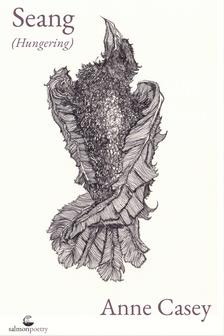
How can we understand British colonial rule of Ireland if we allow atrocities to recede into the curtains of history? On reading Anne Casey’s latest work, it seems that to speak of hunger under such oppression is to “speak back to Empire” (p14). It also seems that the easiest way to break people down is to starve them, systematically ban their language, and to ban as well, their gods, and then their children.
Like Casey, cover artist Anthony Quinn is an Irishman living in Sydney—a city founded on the unceded land of the Gadigal people of the Eora Nation. In a striking pen and ink rendering, Quinn presents a mythical dead crow which, in its quietest hour, is asked to carry the national sorrow of An Gorta Mór (The Great Irish Famine) whose peak years lasted from “1845 until 1849” (p125). As the crow’s lifeless wings are wrapped around its decaying body in a bleak burial blanket, a stippled beak renders the bird incapable of continuing to sing or cry “Cá, cá, cá—” (p29). Like the children of the famine softly calling for their mothers, the bird eventually falls silent.
Launched during “Samhain” (p103) on the 180th anniversary of the Great Irish Famine, this work sings to the spirit of the famine refugees so that those who have never experienced hunger may recognise its significance. As the Irish saying in the epigraph reminds us, “A well-fed person doesn’t understand a hungering one” (p6).
Read my full review at Compulsive Reader:
Seang (Hungering) by Anne Casey